
How to Live in an RV With a Family: A Practical Guide for Full-Time Family Life on the Road
How to Live in an RV With a Family: A Practical Guide for Full-Time Family Life on the Road
Living in an RV with a family is completely doable, and for many families it becomes one of the best decisions they have ever made. The practical keys are choosing the right size RV, building daily routines that work in a smaller space, handling logistics like schooling and mail, and managing the RV itself so it stays reliable. Families who plan ahead thrive. Families who wing it often struggle within the first few months.
How Do You Choose the Right RV for Full-Time Family Living?
The RV you choose will either make family life on the road feel manageable or make it feel miserable. This is the single most important decision in the entire process.
For families with two or more kids, you need separate sleeping zones, a real kitchen, at least one full bathroom, and meaningful living space when parked. The RV types that consistently work best for full-time family living are:
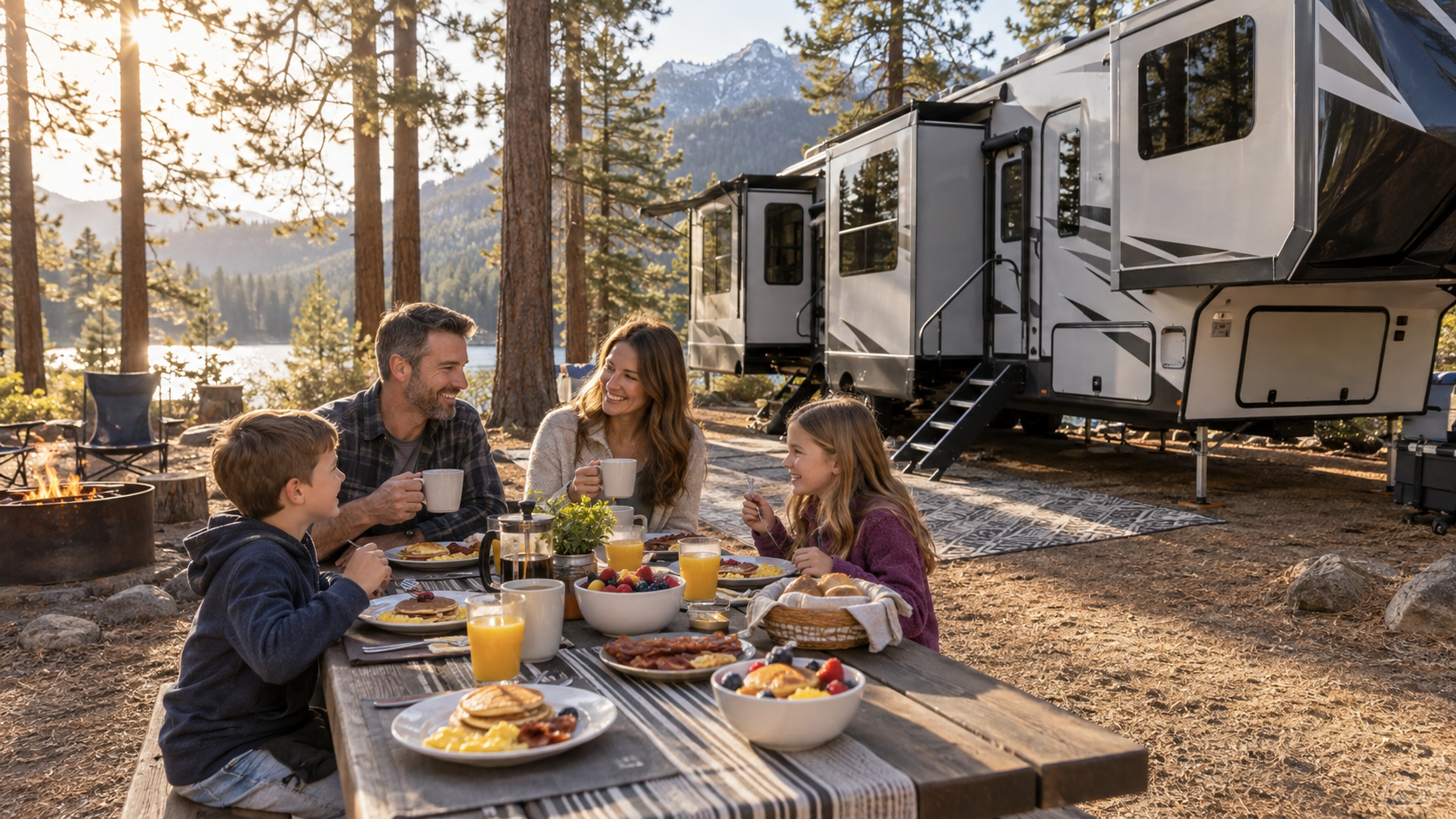
Fifth wheels in the 36- to 42-foot range offer the most residential floorplans. A separate master bedroom, a dedicated bunk room for kids, a full kitchen, and multiple slide-outs give families actual living space rather than cramped quarters. Fifth wheels are the most popular choice among full-time families for good reason.
Large travel trailers with rear bunk rooms are a more budget-friendly path to a family-functional floorplan. The trade-off is that they require a capable tow vehicle, and the living space is typically a bit tighter than a comparably priced fifth wheel.
Class A motorhomes in the 36-foot-and-up range work well for families who move frequently. Everything travels in one unit, which simplifies travel days considerably. Bunk configurations are available on many Class A floorplans.
Class C motorhomes offer a middle-ground option. They are generally less expensive than Class A coaches and often come with bunk over-cab areas plus additional bunk slide configurations.
The non-negotiables for full-time family use are a private master bedroom with a door, a dedicated sleeping area for children, a full bathroom, and enough kitchen space to cook real meals daily.
How Do You Set Up Daily Routines in an RV With Kids?
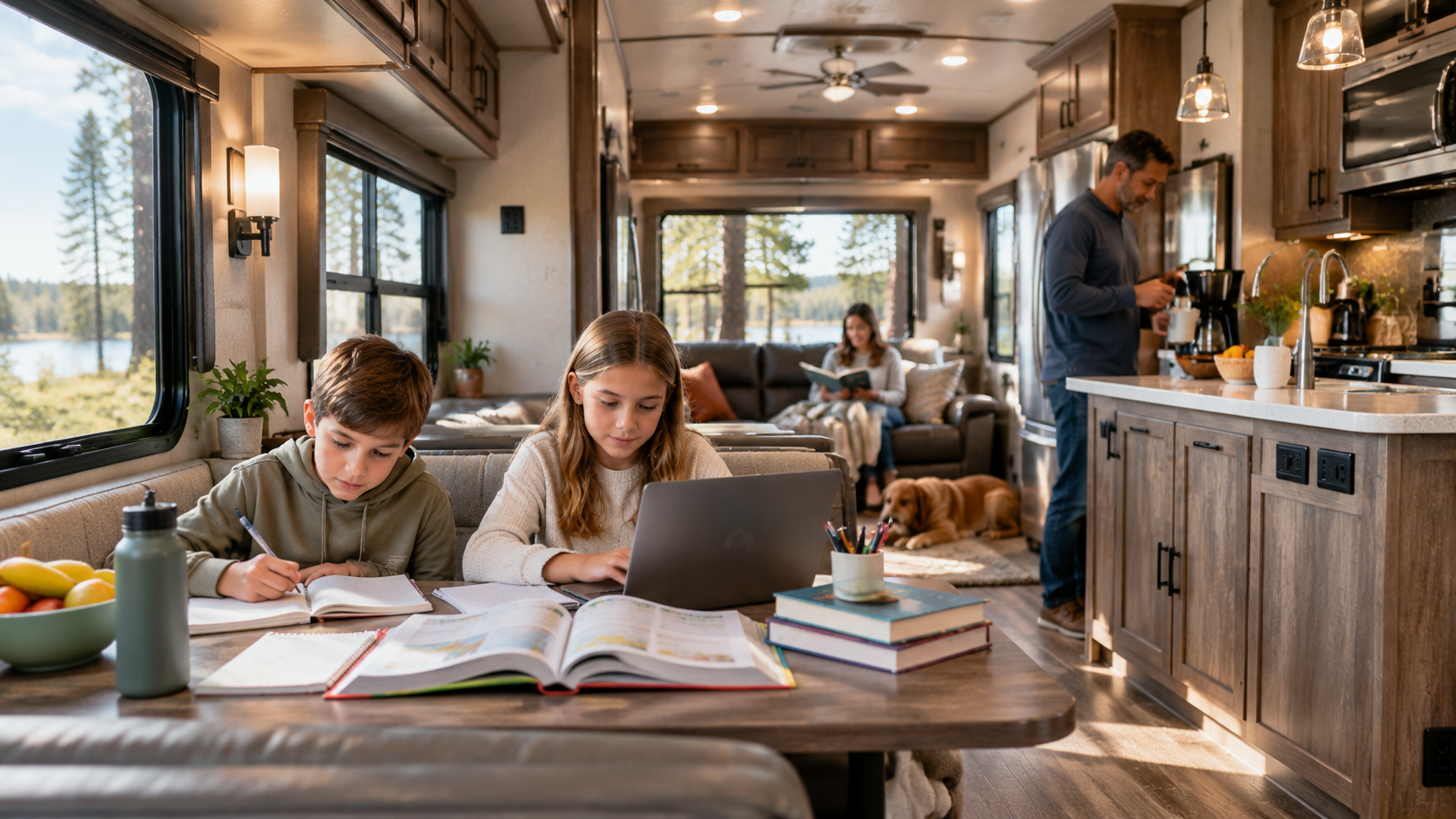
One of the most consistent pieces of advice from experienced full-time RV families is this: routines matter more in a small space than they do in a house.
Without structure, a small shared space becomes chaotic quickly. With structure, even a 38-foot fifth wheel feels workable for a family of four or five.
A practical daily routine for full-time RV families typically looks something like this:
Morning: Everyone has assigned tasks before school or activities begin. This includes making beds, tidying their sleeping area, and completing any chores. In an RV, clutter accumulates fast. A 10-minute morning tidy keeps the space livable.
School hours: Designate a specific time block for schoolwork. The dinette or a dedicated homework area works well. Kids who know exactly when school time starts and ends adjust more easily than those with a floating schedule.
Afternoon: Outdoor time is essential. One of the advantages of RV living is proximity to parks, campgrounds, trails, and open space. Build in outdoor activity daily, both for the kids and for everyone's mental health.
Evening: Shared cooking, meal cleanup, and winding down. Family dinners are genuinely easier in an RV because there is nowhere else to go. Proximity can be a gift.
Bedtime: A consistent bedtime routine in separate sleeping zones makes a real difference. Kids in their bunk room, adults in the master bedroom with the door closed. Privacy matters even in a small space.
How Do You Handle Schooling for Kids in a Full-Time RV?
Schooling is the question families ask most often before making the jump to full-time RV life. The good news is there are more options than ever.
Homeschooling is the most flexible approach and works well for families who move frequently. Many states, including California, allow parents to file a private school affidavit to homeschool legally. Curriculum options range from structured boxed programs to online courses that follow standard grade-level progressions.
Online public schools (sometimes called virtual charter schools) are tuition-free and allow children to work through state-accredited curriculum remotely. The catch is that some programs require students to remain residents of the state, which can be a limitation for families who travel across state lines regularly.
Hybrid schooling works well for families who stay in one region for extended periods. Some areas have homeschool co-ops where kids attend in-person classes two or three days per week and complete the rest of their work independently.
Enrolling locally is an option for families who park for a semester or longer in one location. Some campgrounds in desirable areas attract long-term RV families specifically because the local schools are good.
The key is having a plan before you hit the road, not after. Deciding how you will handle schooling, which curriculum you will use, and how you will structure the school day is part of the preparation, not an afterthought.
How Do You Manage Storage and Organization in an RV With a Family?
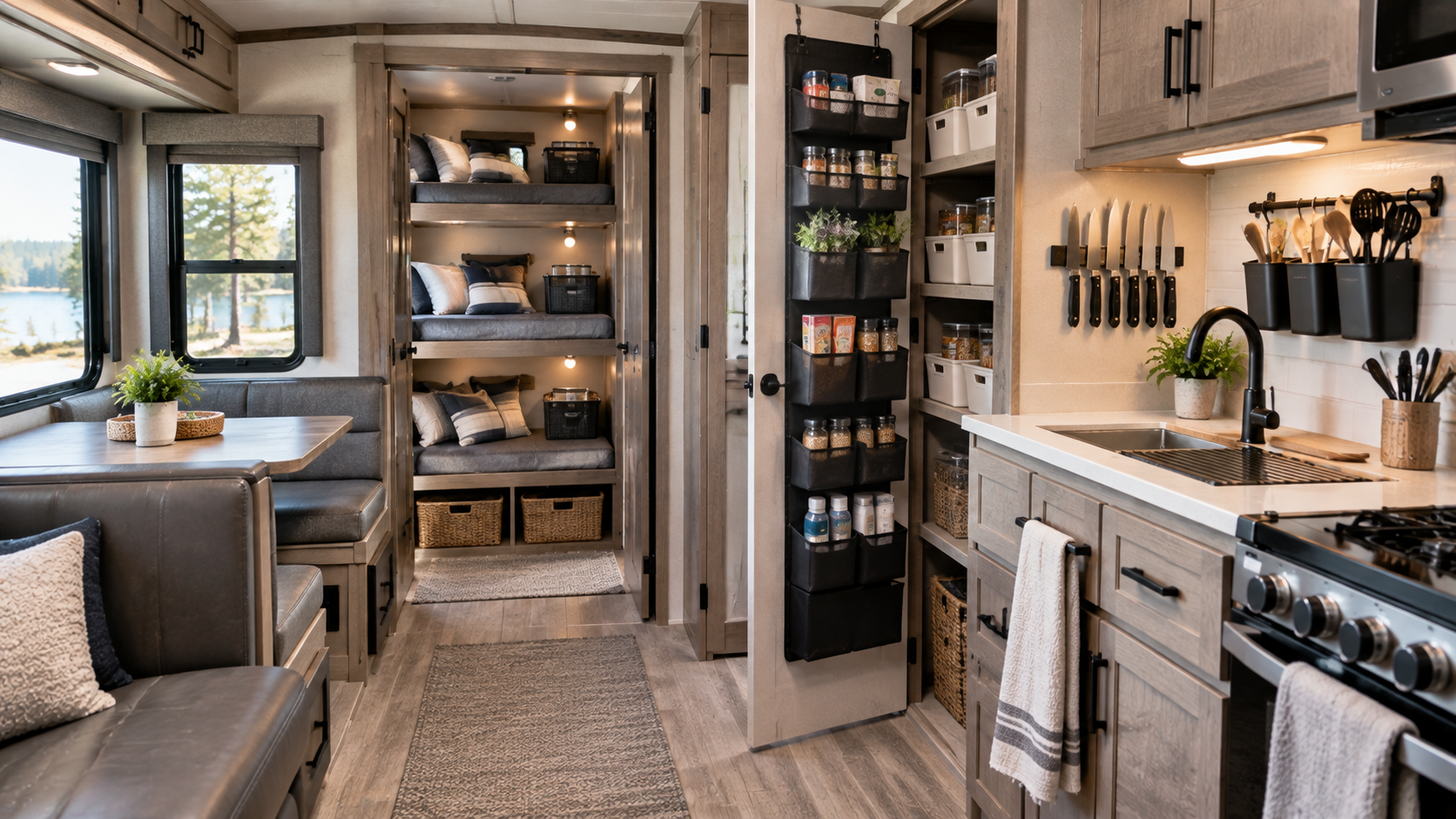
Storage discipline is one of the skills every full-time RV family eventually learns, usually the hard way in the first few weeks.
The basic principle is simple: every item needs a designated place, and every person needs to be in the habit of returning things to that place. In a house, clutter can spread across multiple rooms. In an RV, clutter has nowhere to hide.
Practical storage strategies that full-time RV families rely on:
Assign ownership of storage zones. Each child gets a specific bin, drawer, or shelf space that is theirs. What fits in that space is what they own. This makes storage management tangible for kids.
Use vertical space. Over-door organizers, magnetic strips in the kitchen, and wall-mounted holders for frequently used items free up counter and floor space significantly.
Exterior compartments for bulk items. Most large fifth wheels and Class A motorhomes have generous basement storage. Tools, outdoor gear, sports equipment, and seasonal items live outside the living space.
One in, one out rule. In a small space, bringing something new in means something old goes out. This applies to clothes, toys, books, and kitchen gear equally.
Under-bed storage is premium space. Use it for items you need access to but do not use daily: extra bedding, off-season clothing, school supplies.
Before moving into the RV full-time, most families benefit from doing a significant downsizing pass. Anything that has not been used in six months is a candidate to donate, sell, or leave behind.
How Do You Handle Laundry, Mail, and Other Logistics?
The practical logistics of full-time family RV life require systems. Here is how experienced families handle the most common challenges:
Laundry: Most RV families use campground laundry facilities or local laundromats. Larger fifth wheels and Class A motorhomes can accommodate a stackable washer and dryer, which is worth the investment for a family. If laundry facilities are not on-site, building a laundry run into the weekly schedule keeps it from becoming a crisis.
Mail: Full-time RV families need a mail forwarding service. Several companies specialize in this, allowing families to have a permanent mailing address while receiving physical mail forwarded to wherever they are. Setting up a P.O. box or using a mail forwarding service is a pre-departure task, not something to figure out on the road.
Legal domicile: Every family member needs a state of legal residence for driver's licenses, vehicle registration, voting, and taxes. Some states are more friendly to full-timers than others in terms of income tax, vehicle registration costs, and ease of maintaining residency without a physical address. Research this thoroughly before departure.
Banking and bills: Set everything to autopay and online statements before leaving. Managing finances digitally eliminates the need for a physical address for most financial correspondence.
Healthcare: Families need a healthcare plan that works across state lines. This means understanding how your health insurance handles out-of-network care, identifying telehealth options for routine needs, and knowing where urgent care facilities are in the areas you travel through.
Internet: Reliable internet is a non-negotiable for most families, both for schooling and for any remote work that funds the lifestyle. A combination of a cellular data plan with a high-data or unlimited cap, a mobile hotspot, and campgrounds that offer reliable WiFi is the most common approach.
What Are the Biggest Challenges of Full-Time Family RV Life and How Do You Handle Them?
Going in with realistic expectations about the challenges saves families from being blindsided.
Limited personal space. Everyone needs some alone time, and in an RV there is not much physical separation available. The solution is intentional scheduling. Time outside, activities away from the RV, and respecting each person's small designated space goes a long way.
RV maintenance. An RV that is lived in full-time experiences wear at a much faster rate than one used occasionally. Tires, slide mechanisms, roof seals, plumbing connections, and appliances all need regular inspection and maintenance. Learning basic RV maintenance skills before you need them is far better than learning them when something fails at a campground three states from home.
Social connection for kids. Children who live in RVs full-time can thrive socially, but it requires more intentional effort than it does in a traditional neighborhood. RV parks with other families, homeschool co-ops, sports leagues at camped locations, and social media groups for full-time RV families all help kids build and maintain friendships.
Campsite availability. Popular destinations book up quickly, especially in California during peak seasons. Full-time families need to plan their travel calendar in advance and build flexibility into their schedule for last-minute changes.
Relationship dynamics. Living in close quarters 24 hours a day changes family dynamics. Most families report that it brings them closer together, but it also accelerates conflict resolution. Families who communicate well and have healthy habits before moving into an RV generally adapt faster.
How Can Sky River RV Help Your Family Get Started?
Sky River RV has California locations in Fresno, Pismo Beach, Paso Robles, and Santa Maria, with a broad inventory of family-sized RVs including fifth wheels, travel trailers, Class A and Class C motorhomes. The team works with families at every stage of the decision process, from first-time questions about floorplans to trade-in conversations for families upgrading to a larger unit.
Financing is available through Sky River RV's financing department, and the trade-in program lets families apply existing RV equity toward a unit that better fits full-time family life.
If you are ready to explore your options, start by browsing the new RV inventory or used RV inventory at skyriverrv.com. You can also visit the contact page to connect with someone who can walk you through which floorplans make the most sense for your family's specific situation.
Frequently Asked Questions
How long does it take for a family to adjust to full-time RV living?
Most families go through a genuine adjustment period of one to three months. The first few weeks involve a lot of problem-solving around storage, routines, and logistics. By the end of the second or third month, most families find their rhythm. Families who prepare thoroughly before moving in typically adjust faster than those who figure things out as they go.
How do you keep kids entertained in an RV without a lot of space for toys?
The most effective approach is shifting entertainment toward experiences rather than possessions. Outdoor activities, national park visits, hiking, swimming, and exploring new towns fill the time that screens and toys might fill at home. Most full-time RV families allow a small bin of toys or books per child and supplement with library cards, which work across most of the country.
Is it cheaper to live in an RV than to rent a house in California?
For many families, yes. California's housing costs are among the highest in the country. Monthly campground fees, even at full-hookup RV parks, are often lower than rental costs in most California markets. The trade-off includes fuel costs, RV maintenance, and a higher upfront cost for a quality family-sized unit. The overall savings depend on how much you move and where you camp.
What do full-time RV families do for healthcare?
Most full-time families use health insurance plans that cover out-of-network care across the country, since they may be far from in-network providers at any given time. Telehealth services have made routine healthcare significantly easier for traveling families. Some families designate a home-base state where they maintain relationships with specific doctors for annual visits and more specialized care.
Can you have pets in a full-time family RV?
Yes, and many full-time RV families travel with dogs, cats, or both. Most campgrounds allow pets, though some have breed or size restrictions. Pets adapt to RV life more easily than most people expect. The practical considerations are ensuring the RV has good ventilation and temperature control for pets when left inside, and planning outdoor time that works for both the family and the animals.
How do full-time RV families handle finances and banking?
The transition to paperless banking and digital financial management is a prerequisite for full-time RV life. Set all bills to autopay, switch all statements to email, and use a bank with no-fee ATM access nationwide. Many full-time families also use a mail forwarding service for any physical correspondence that cannot be handled digitally.
What happens if the RV breaks down with the whole family inside?
Roadside assistance programs specifically designed for RVs are available and are a worthwhile investment for full-time families. These programs cover towing, tire changes, and in some cases temporary lodging while repairs are made. Maintaining the RV proactively, keeping a basic tool kit and spare parts on hand, and knowing how to handle common issues like a blown tire or a slide malfunction reduces the risk of being stranded.
Final Takeaway
Living in an RV with a family is less about roughing it and more about intentional living. The families who do it well are not the ones with the most expensive RV or the most elaborate setup. They are the ones who chose the right floorplan for their actual family size, built routines that work in a small space, handled the logistics before they became problems, and stayed flexible when things did not go exactly as planned.
The lifestyle rewards families who prepare. Start with the right rig, build your systems before you need them, and give everyone in the family a role in making it work.
Sky River RV serves families across California who are exploring full-time and extended RV living. Browse fifth wheels, travel trailers, Class A motorhomes, and Class C motorhomes at skyriverrv.com, explore RV financing options, or contact the team to talk through what will actually work for your family.